The illustration has loaded; the main content also appears later on the page.
Guidelines for civilians / Building preparation
Preparing civilian buildings for drone attacks
Preparing the apartment and building: a guide for civilians for defense against drones
01
Choosing the protected space in the apartment and applying shelter rules
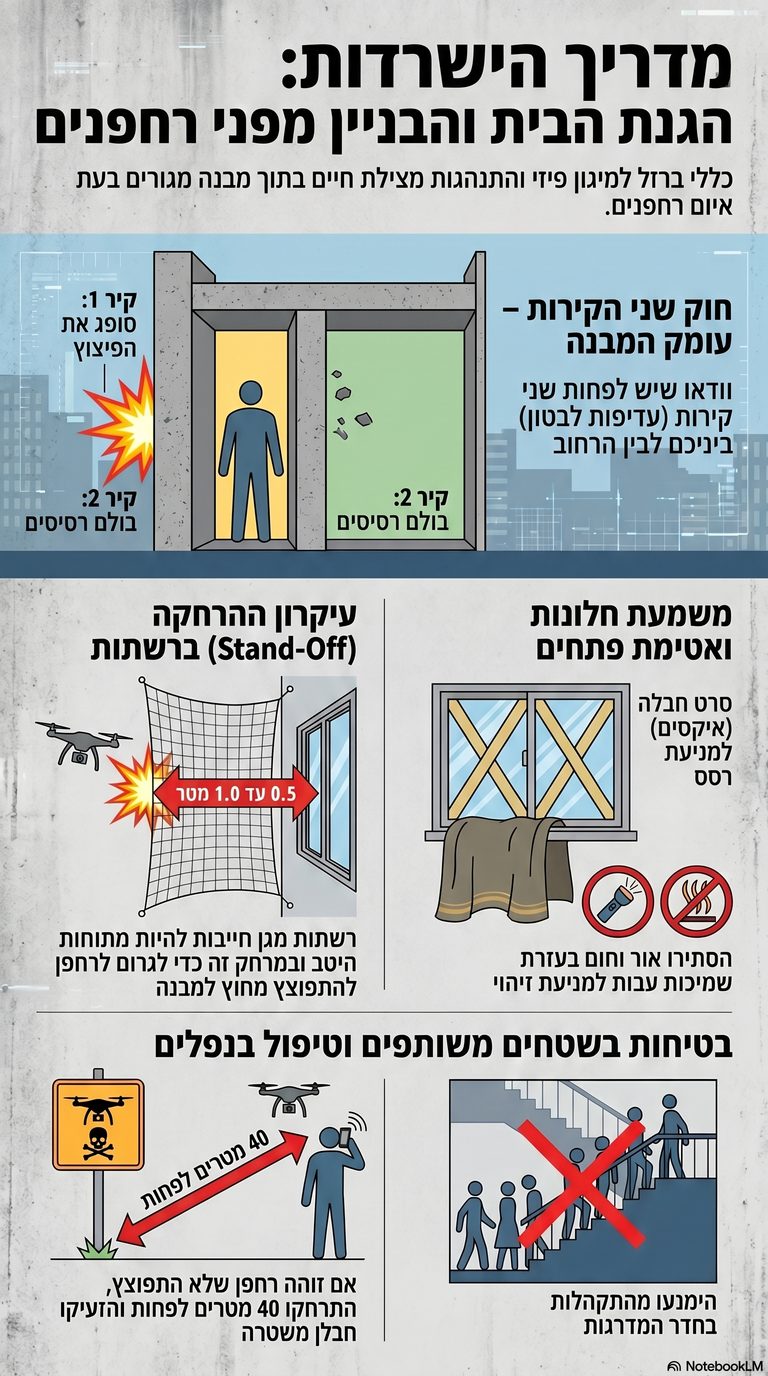
The "two-wall" rule: When staying in the apartment during an alert, you must move deeper into the structure and ensure there are at least two supporting walls between you and the street outside. The first wall will absorb the drone’s direct blast, and the second wall will block the shockwave and concrete and glass fragments.
Identifying suitable walls and structures: Not every wall or structure provides protection. Thin walls, hollow blocks, or light roofs (such as sheet metal) are not enough to stop a kamikaze drone strike. Shelter should be chosen behind thick concrete walls, in a safe room, an internal stairwell, or the building basement.
02
Window protection and sealing openings
Window discipline and fragment hazard: It is recommended to tape "X" shapes on window panes with Duct Tape to reduce dangerous dispersal of glass fragments in the event of a nearby shockwave.
Concealing presence: Hang thick blankets and blackout curtains over windows to block light and heat leakage from the apartment to the outside. Never observe directly from the window line to look for the drone—stay away from the window and remain deeper inside the room.
Blocking "dead" openings: If the building or apartment has openings or windows that are not essential for ventilation or entry, seal them hermetically using heavy objects or cabinets.
03
Installing protective nets (stand-off principle)
Stand-off principle (Stand-Off): The goal of installing nets on balconies or over large windows is to create a physical barrier that causes the drone to explode outside and keeps the fragments outside the apartment. For this, the required distance between the net and the building wall or window must be between 0.5 and 1.0 meters.
Danger of a loose net (must be taut): A protective net that is not stretched tightly is a deadly hazard. The net will "stretch" with the drone’s momentum and allow the blast to penetrate the stand-off distance and hit the wall. The net must be stretched and secured (like a strong sports net) as much as possible to completely eliminate its natural flexibility.
Pigeon nets: In building forecourts, entrances, or narrow alleys between buildings, it is advisable to deploy pigeon nets. They act as an invisible trap for the analog cameras of enemy drones and may stop a drone flying at low altitude.
04
Safety rules in the building’s shared areas
Avoiding gatherings: There is a dangerous tendency toward complacency and gathering in supposedly "protected" areas such as building entrances or covered courtyards. Enemy drones look for exactly these gatherings. In case of an alert, keep distance and spread people out, including in courtyards and stairwells.
A drone is like a bomb: A drone caught in a balcony net, or that fell in the building courtyard and did not explode, is a live and deadly explosive device in every respect (UXO) waiting to detonate. It is absolutely forbidden to approach it, touch it, or try to free it. Move all residents away to a safety radius of at least 40 meters and immediately call police bomb disposal.