The illustration has loaded; the main content also appears later on the page.
Guidelines for civilians / Net types
Civilian guide: net types for defense against drones and installation principles for homes
A
Part A: Net types and their purpose in the civilian space
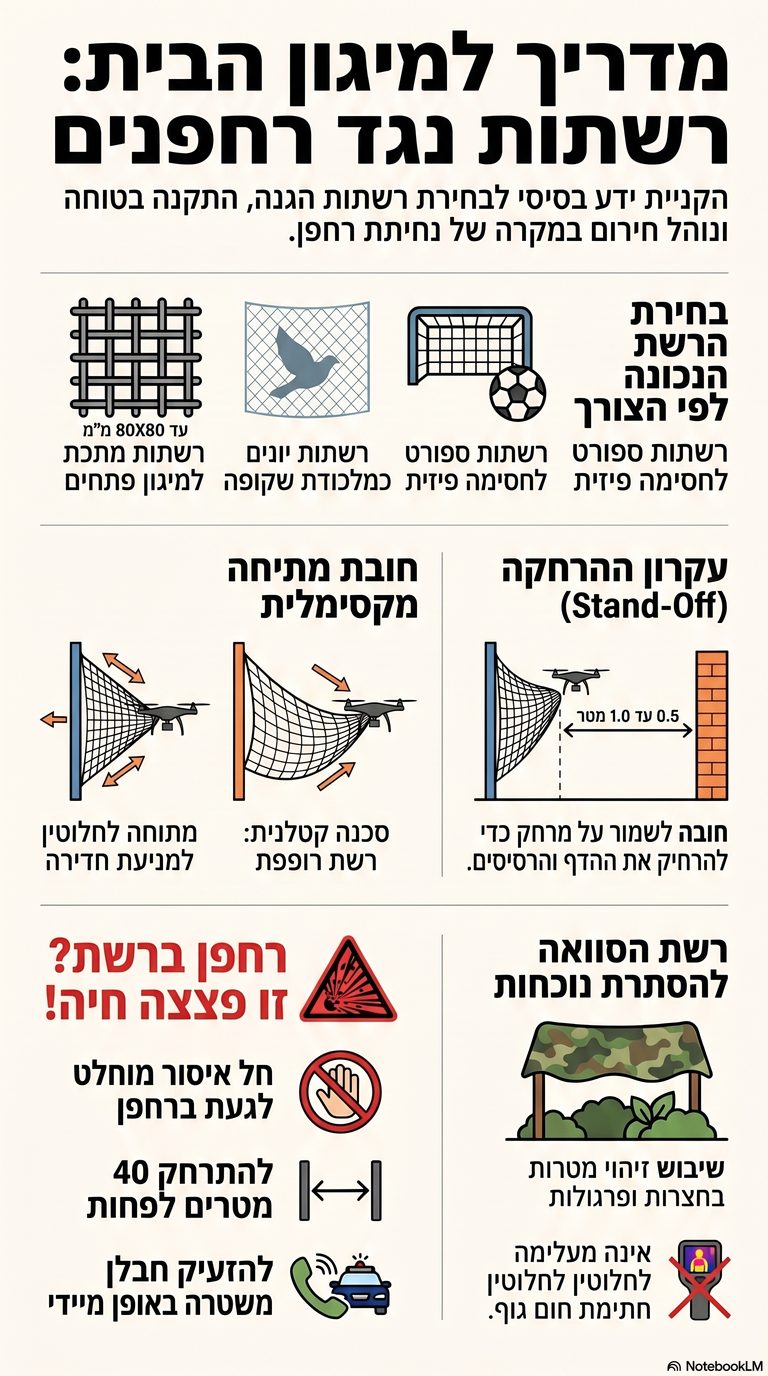
Sports nets (strong physical protection)
Designed for physical and kinetic blocking of the drone thanks to their durability and high energy absorption capacity. In the civilian environment, they are ideal for installation on open balconies, over large windows, and to cover the home’s vital access points.
Pigeon nets (transparent trap)
They serve as a tactical trap because they are almost invisible to the often blurry analog cameras of enemy drones. It is recommended that building committees and authorities deploy them in building entrance forecourts, narrow alleys between houses, and low passageways.
Camouflage nets (concealing presence)
Designed to prevent target identification and create psychological warfare that causes the drone operator to become discouraged and abandon the target. Suitable for deployment over private courtyards, pergolas, and neighborhood gathering areas to conceal civilian presence from a bird’s-eye view. However, they provide only partial thermal disruption and do not completely eliminate body heat signature.
Metal and steel nets
Suitable for protecting small openings or vehicles. To stop a drone, a side net with a mesh size no greater than 80x80 mm should be used (75x75 mm recommended). If overhead protection is installed (a protective canopy above the yard), a denser 50x50 mm metal net should be used to prevent penetration by munitions dropped from above.
B
Part B: Core installation principles in the apartment and building
Stand-off principle (Stand-Off)
The goal is to create a physical barrier that causes the drone to explode outside and keeps the shockwave and fragments away from the family. Therefore, a distance of 0.5 to 1.0 meters must be maintained between the installed net and the building walls or glass windows.
Danger of a loose net (must be taut)
A critical safety warning concerns sports nets and pigeon nets—a loose, elastic net is a deadly hazard. The net may "stretch" inward with the drone’s momentum (its inertia), allowing it to penetrate the stand-off distance (Stand-Off) and explode directly against the wall. The net must be stretched and secured as much as possible to completely eliminate its natural flexibility.
C
Part C: Routine handling of drones caught in a net
A drone in a net is like a bomb: A drone caught in a balcony or yard net (even if it did not explode) immediately becomes a live and deadly explosive device (UXO) waiting to detonate.
Iron rule - do not touch: It is absolutely forbidden to approach the drone, touch it, or try to free it from the net yourself.
Evacuation: Immediately move all household members and neighbors to a safety distance of at least 40 meters, and immediately call police bomb disposal to the scene to remove the bomb.