The attached infographics appear here in order, followed by the full text from the PDF file as a readable web page, without embedding the PDF.
6 infographicsShown one after another in the order of the attached file.
14 text pagesThe text was extracted from the PDF text layer and is shown here for reading on the site.
Mounted movementThe source document uses the terms crew, commander, driver, and signalman.
Infographics
Visual instructions in order
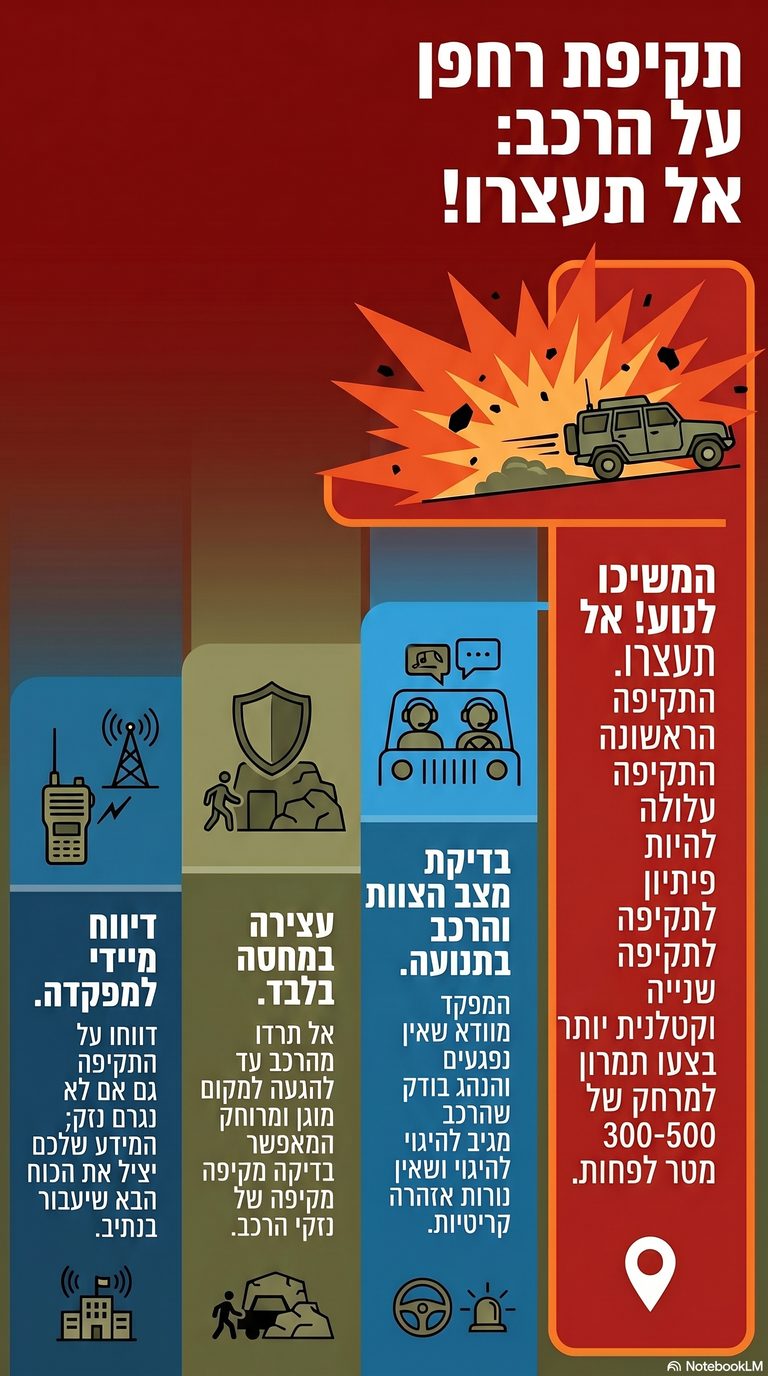
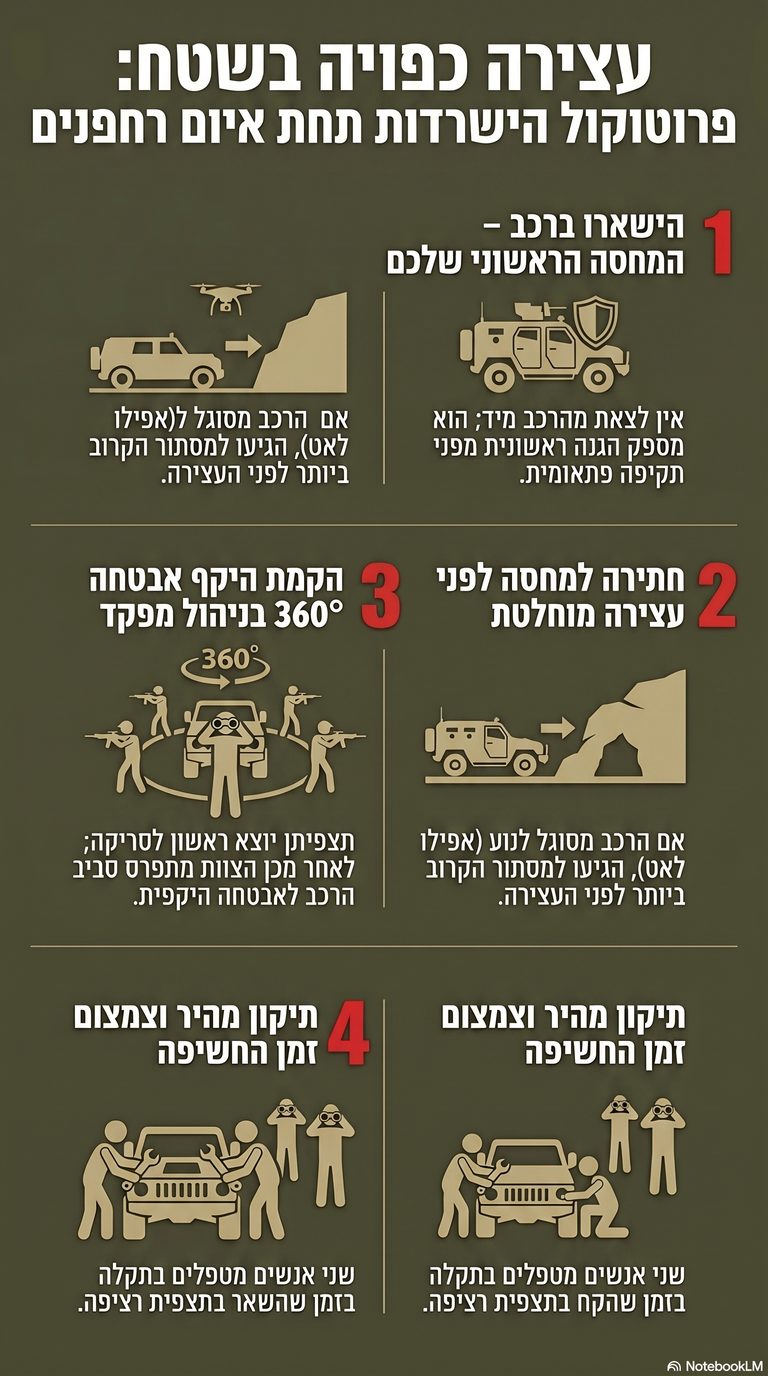
01Protocol for the first seconds: immediate defense against an FPV drone02Out of sight? Do not lower your alertness03FPV drone spotted? Survival guide for vehicle passengers04Survival guide: lone driver vs. an FPV drone05Drone attack on the vehicle: do not stop06Forced stop in the field: survival protocol under drone threat
Structured text from the PDF
Operational guide: protection from FPV drones during vehicle movement
Page 01
Introduction and preliminary preparation
Operational guide: protection from FPV drones during vehicle movement
This guide presents an organized way to reduce risk while moving by vehicle under an FPV-drone threat. It focuses on preparation, role coordination, alertness and fast response when a threat is discovered.
The document does not replace orders, unit procedures or instructions from commanders and authorized bodies. If there is any contradiction, follow the official instructions.
1. Preliminary preparation: 10 required steps before movement
Early preparation is the most important layer of protection. Route planning, knowledge of risk areas, role allocation and a clear briefing let the crew respond quickly instead of improvising under pressure.
Step 1: collect and analyze route information
Why it matters: Studying the route in advance helps identify exposed areas, possible cover, observation points and places where attacks have occurred before.
Study the route with current maps, satellite imagery and relevant field information.
Collect information from commanders, intelligence personnel, neighboring units, engineers and electronic-warfare specialists.
Mark previous attack locations, areas visible to the enemy, high ground, bridges and open sections.
Page 02
Route planning, risk levels and movement timing
Step 2: plan the route and backup options
Why it matters: A concealed route and a planned alternative give the crew flexibility if the way is blocked, attacked or must be evacuated.
Choose a route that passes near forest, buildings, low terrain or other features that reduce exposure when possible.
Avoid long movement through open terrain.
Prepare at least one alternate route when the mission and orders allow it, and make sure the crew knows it.
Main rule: plan the route so that at every stage there is a possible direction toward cover or out of the dangerous area.
Step 3: divide the route into sections by risk level
Dividing the route helps the crew know when maximum alertness is required and when movement can be calmer.
Protected: covered passages, concealed areas or sections with relatively good protection.
Relatively safer: dense forest, low terrain and sections without a clear enemy line of sight.
Dangerous: open fields, hills, ridges and exposed roads.
Especially dangerous: places where attacks occurred before, bridges, narrow roads with little maneuver room and very open terrain.
Step 4: choose the movement time
Time of day and weather affect detection and operation of drones.
Check a detailed weather forecast before departure.
When compatible with the mission and orders, prefer conditions that make drone detection and operation harder.
Learn local patterns of drone activity in the sector and avoid the most dangerous hours where possible.
Page 03
Waypoints, signals intelligence and vehicle checks
Step 5: define waypoints
Where satellite navigation may be disrupted, visual waypoints are an important navigation tool.
Download maps and satellite images to an available device in advance.
Define clear, durable waypoints: intersections, buildings, bridges, power lines and prominent terrain features.
Phrase navigation instructions simply, for example: "300 meters after the destroyed building, turn right."
Critical instruction: if you lose orientation, return to the last known waypoint instead of continuing to improvise.
Step 6: signals intelligence and electronic warfare
Electronic tools are useful only when the crew understands what they can provide and what their limits are.
Learn from professional sources what the threat characteristics are in the sector.
Check authorized warning and protection equipment before departure.
If the crew is not familiar with the equipment, get instruction from an authorized person before using it.
Step 7: inspect the vehicle
A technical failure in exposed terrain can become a life-threatening event. Before departure, perform a structured check.
Check the engine, fuel, oil, water, brakes, tires, lights and electrical systems.
Make sure recovery tools, first aid, communications and personal equipment are present and accessible.
Make sure loose equipment will not block exits or fast movement inside the vehicle.
Page 04
Protecting the vehicle, crew and passengers
Step 8: protect the vehicle and crew
The goal is to reduce casualties and preserve the ability to move and evacuate. Protection does not remove the threat; it buys time and improves survival chances.
Check the condition and integrity of existing protection before movement.
Make sure crew and passengers wear helmets, protective vests where required, and know the exit points.
Arrange equipment so it does not block doors, windows, exit routes or access to first aid.
Explain to passengers in advance how to act if a drone is detected, a forced stop occurs or an evacuation order is given.
Personal readiness check before movement
Area
What to check
Why it matters
Protective equipment
Helmet, vest, eye protection and gloves as required.
Reduces injury from fragments and objects inside the vehicle.
First aid
Accessible kit, tourniquets and basic knowledge among crew members.
Allows immediate response until evacuation.
Exiting the vehicle
Doors, seat belts, personal equipment and an agreed evacuation command.
Prevents delay and confusion under pressure.
Page 05
Communications, role allocation and departure briefing
Step 9: organize communications
Clear communications reduce confusion. Before departure, define who reports, who receives reports and what short warning language the crew uses.
Check that all communication devices work and batteries are charged.
Define short warning phrases, for example: "drone above", "drone left" or "nearby hit".
Decide who reports outward and who continues scanning while the report is made.
Step 10: allocate roles in the crew
Everyone should know their role in advance. During the event there is no time for discussion.
Role
Main responsibility
Vehicle commander
Decisions, movement or evacuation orders, personnel count and report coordination.
Driver
Keep moving, maneuver according to command or immediate threat, and reach cover when possible.
Observer
Continuous scan of sky, sides and rear, and clear voice warning.
Radio operator
Report to the relevant elements and keep a communication channel available.
Passengers
Stay calm, lower their profile during threat, and follow the vehicle commander's instructions.
Page 06
Crew briefing for action during movement
2. Crew briefing for action in different circumstances
Before every movement, brief the sequence of actions out loud. A good briefing prevents freezing, shouting and contradictory orders.
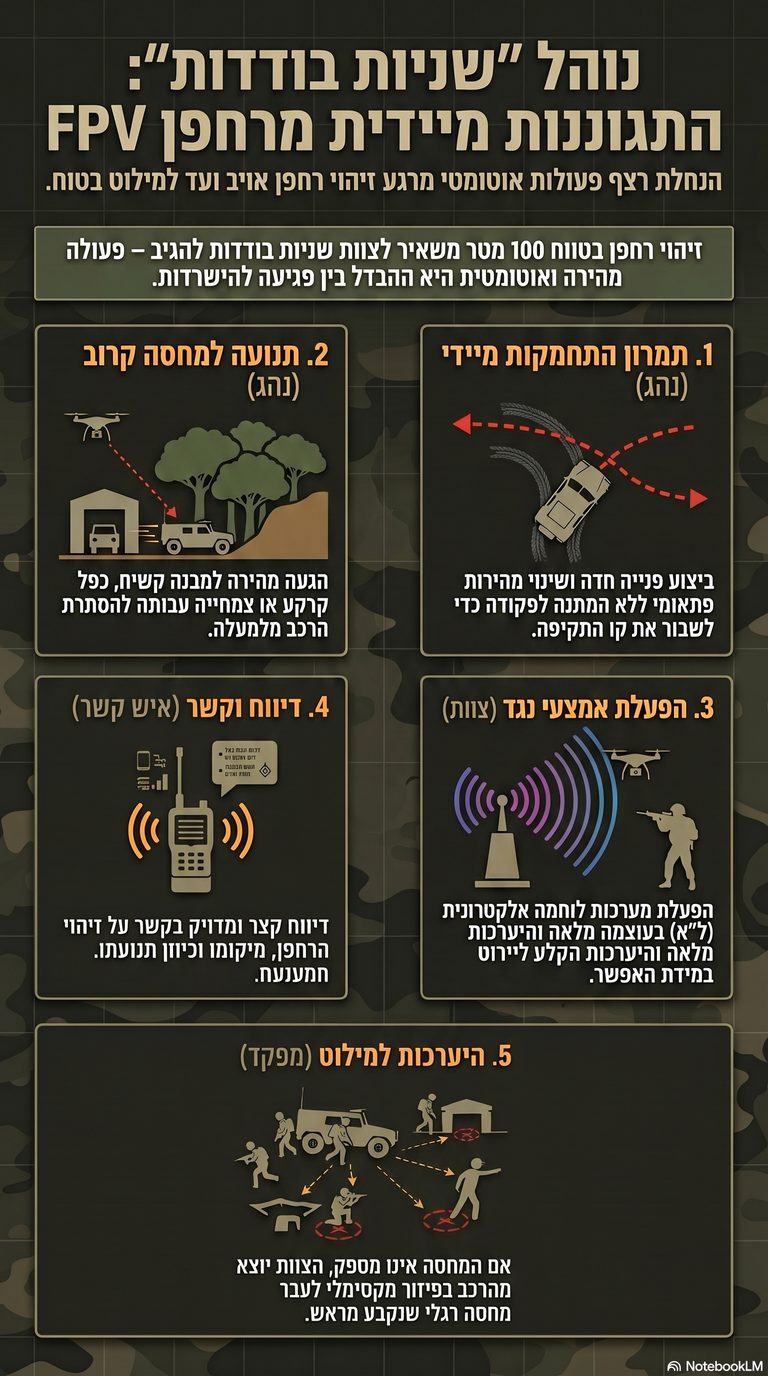
Warning of a possible threat: the radio operator or authorized equipment operator announces briefly and clearly that there is a threat in the area.
Initial crew response: nonessential conversation stops, protective equipment is checked, alertness rises and the surroundings are scanned.
Confirmed detection report: the first person who detects the threat calls out the type and direction clearly, without panic.
Action sequence: the driver maneuvers, the commander decides whether to keep moving or seek cover, and the radio operator reports.
If the vehicle is hit: the commander gives an evacuation order only when needed and directs the crew toward the nearest cover.
Guiding principle: short commands, clear roles and action according to a sequence the crew has already practiced.
Page 07
Universal action rules
3. General action rules for crew and passengers
Do not freeze: organized action is better than waiting without a decision.
Do not stop in exposed terrain without need: a stopped vehicle is an easier target.
Keep dispersion when leaving the vehicle: do not crowd at one door or behind one piece of cover.
Maintain observation: even if the threat disappears, continue scanning in other directions.
Do not return to the vehicle without the commander's decision: after a hit or stop, return only if it is required and relatively safe.
Attention management during movement
The driver focuses on driving and responding to the road. The observer and passengers help scan, but they do not overload the driver with shouting. Only short, clear warnings are spoken aloud.
Page 08
Actions when an FPV drone is detected
4. Actions when an FPV drone is detected
Example situation: an observer identifies a drone approaching at short range. The crew has only a few seconds to respond.
Immediate evasive maneuver: the driver changes direction and speed to disrupt the attack line. Do not wait for a command if the threat is immediate and clear.
Move to cover: the driver moves quickly toward the nearest cover, such as trees, a building or a fold in the ground.
Use approved countermeasures: the crew activates only measures that were defined in advance and approved for use.
Prepare for defense: if conditions and procedures allow it, the relevant role holder prepares according to the commander's orders.
Report: the radio operator briefly reports drone detection, approximate location and direction of movement.
Prepare to evacuate: if cover is insufficient and the drone continues approaching, the commander gives an evacuation order and the crew moves to cover while keeping dispersion.
Situation
What to do
Why it matters
Drone detected
Evasive maneuver and change of direction/speed.
Makes it harder to maintain the attack line.
Nearby cover
Move toward it without stopping in open terrain.
Reduces exposure and increases survival chances.
Continuing threat
Maintain alertness, scanning and continuous reporting.
A drone that disappeared may reappear from another direction.
Page 09
Scenarios 1-2: nearby hit and early drone detection
Scenario 1: explosion near a convoy
Example situation: a convoy is moving on a road, an explosion is heard and the first vehicle is hit.
Stop briefly only if needed for assessment, and do it at the roadside, not in the center.
The crew stays in the vehicle until a decision is made, unless immediate danger requires exiting.
The observer scans for an additional threat and the radio operator reports.
The commander decides whether to keep moving, reach cover or evacuate.
Scenario 2: early drone detection
Example situation: a drone is detected before it reaches immediate range.
The driver begins maneuvering and searches for cover.
The observer keeps visual contact as much as possible and gives direction.
The radio operator reports briefly without overloading the driver.
The commander considers whether continued movement is safer than stopping.
Action
What to do
Why it matters
Nearby explosion
Quick assessment and movement/cover.
Prevents becoming a static target.
Early detection
Move to cover, scan and report.
Buys time and reduces exposure.
Page 10
Scenarios 3-4: lost drone contact and passengers in the vehicle
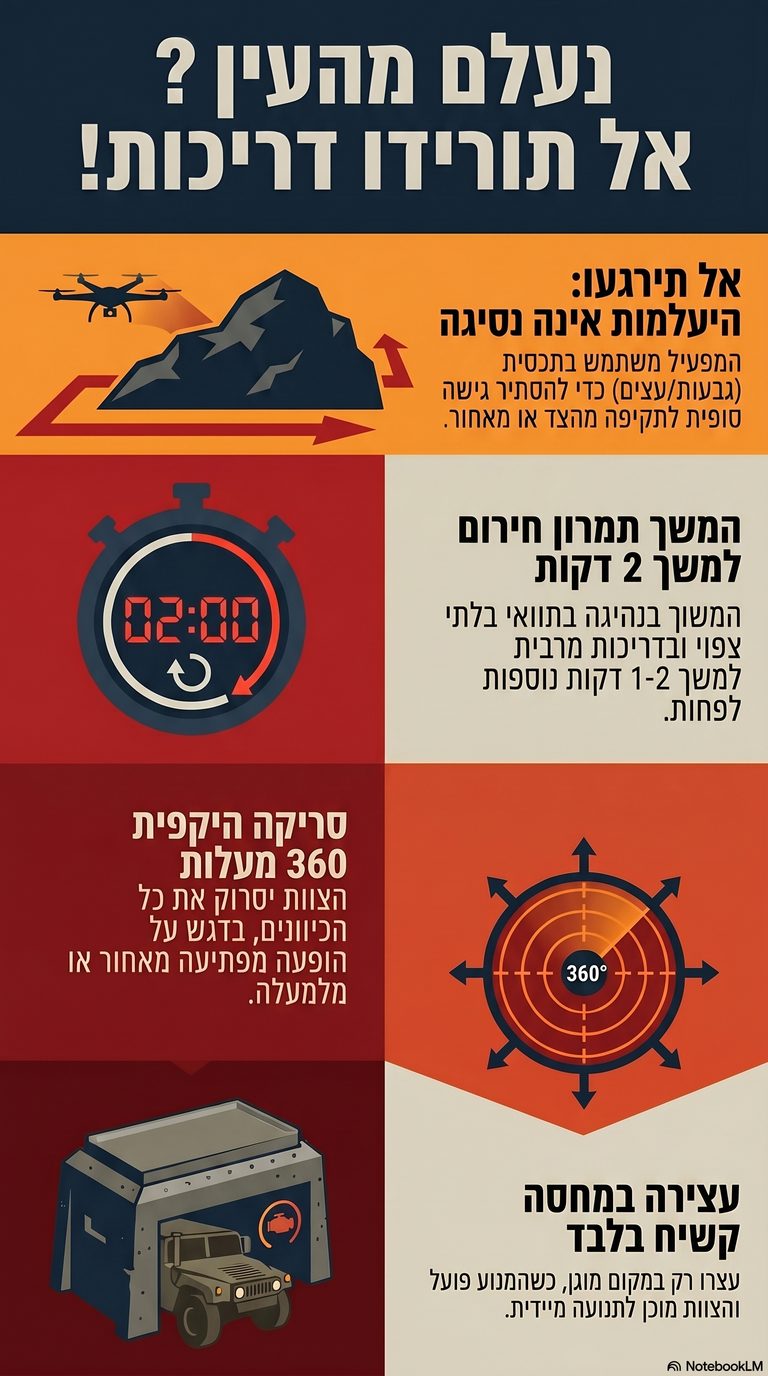
Scenario 3: FPV drone disappears from view
Example situation: a drone was detected, and after a maneuver it disappeared. There is no visual or audio contact.
Do not relax immediately: disappearance does not necessarily mean withdrawal. The drone may be using terrain to arrive from another direction.
Continue cautious movement: keep an unpredictable path and stay alert for additional time.
Scan all around: the observer and crew check behind, to the sides and above.
Stop only under cover: if you must stop, do it in a relatively protected place and remain ready to move immediately.
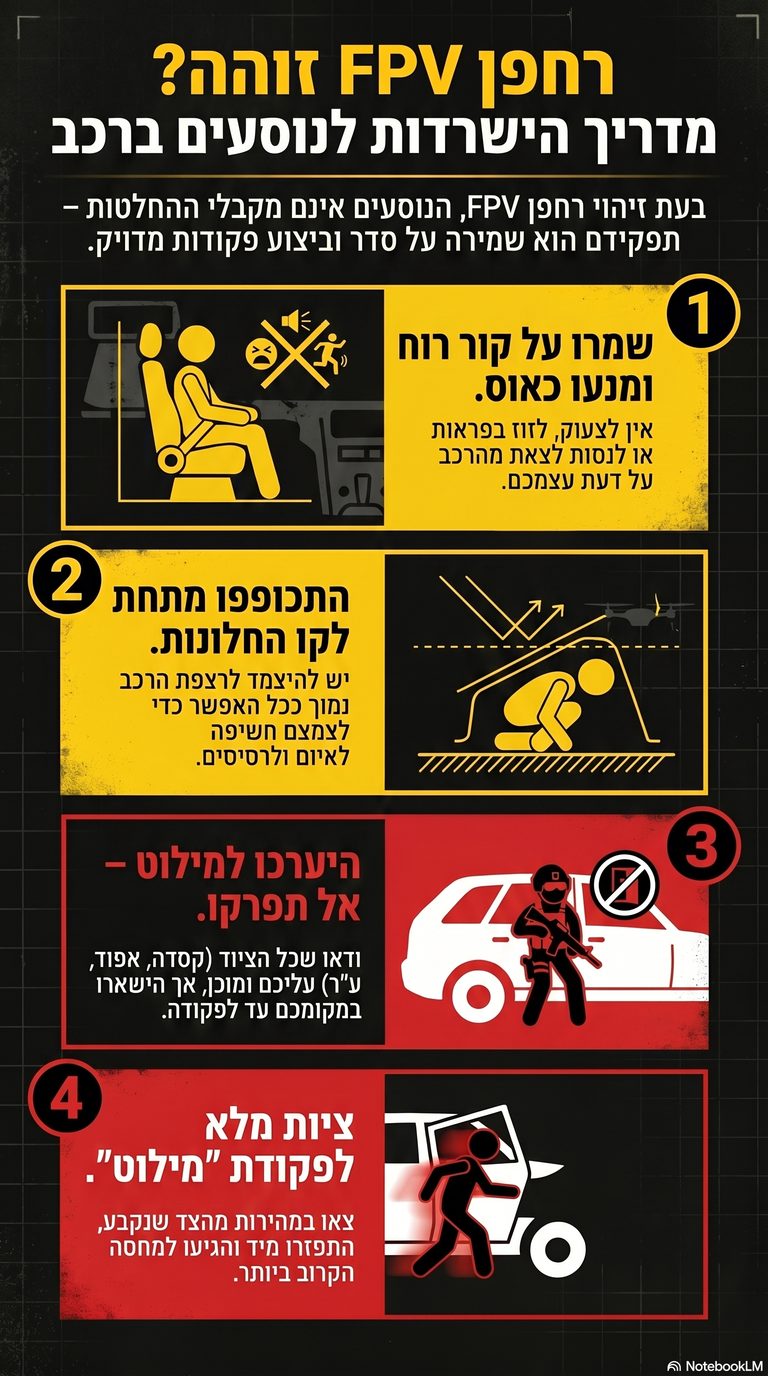
Scenario 4: passengers who are not part of the organic crew
Example situation: the vehicle is carrying additional passengers who do not know the crew procedure.
Do not shout, move wildly or leave the vehicle on your own initiative.
During a threat, lower your profile below the window line as much as possible.
Keep personal equipment ready, but wait for a command.
On an evacuation command, exit quickly and in order from the assigned side, disperse and reach cover.
For passengers: your role is to reduce chaos, stay quiet and follow the vehicle commander's instructions.
Page 11
Scenarios 5-6: lone driver and forced stop
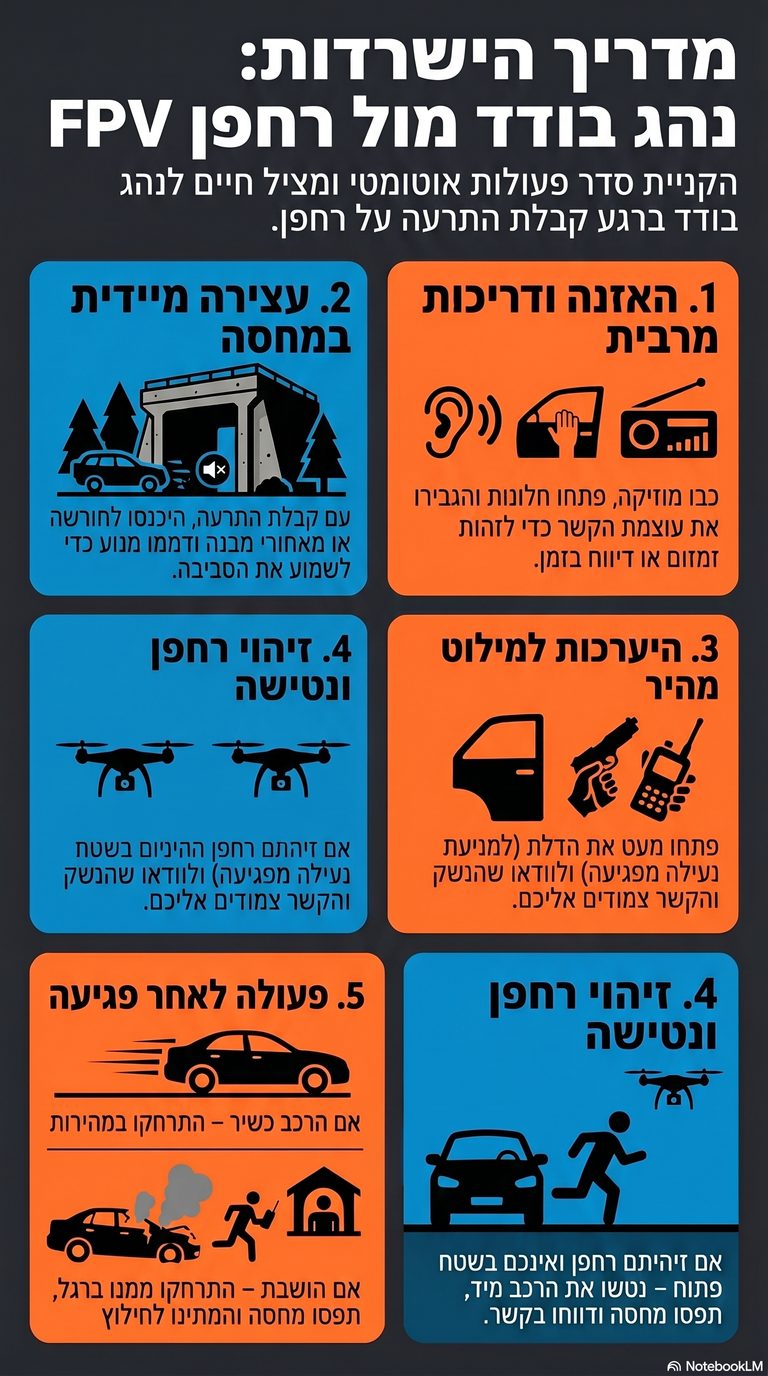
Scenario 5: lone driver
Example situation: a lone driver receives a radio warning about an FPV threat in the sector.
Remove distractions, open windows as needed and listen to the environment and radio.
If there is a warning, search for nearby cover and reduce exposure.
Make sure communications, personal equipment and the exit route are available.
If the threat is detected and the terrain permits, move away from the vehicle to cover and report as possible.
After an attack, if the vehicle can move, leave the area; if it is disabled, take cover and wait for recovery according to orders.
Scenario 6: technical or forced stop
Example situation: a tire or engine fault forces a stop in dangerous terrain.
Do not exit immediately if there is no immediate danger. The vehicle provides initial cover.
If the vehicle can still move, even slowly, try to reach cover before stopping fully.
If exiting is required, the commander manages an orderly exit and the crew disperses for observation and perimeter security.
Repair quickly while part of the crew continues observation. The aim is to reduce stop time.
Situation
What to do
Why it matters
Forced stop
Try to reach cover and maintain observation.
Reduces exposure while the vehicle is static.
Repair
Only a few people work on the fault while others scan.
Prevents the whole crew from becoming absorbed in repair.
Page 12
Scenarios 7-9: hit, shelling and significant damage
Scenario 7: attack without significant damage
Example situation: an explosion shakes the vehicle, but the engine works and there are no casualties.
Keep moving and do not stop in exposed terrain.
The commander performs a quick crew status check while moving.
The driver checks whether the vehicle responds to steering and whether there are signs of failure.
Stop for a full check only after reaching a relatively protected location.
Report the attack even if there is no significant damage.
Scenario 8: shelling or indirect fire without significant damage
Increase movement and change direction according to terrain and orders.
Look for substantial cover that hides the vehicle from observation and reduces exposure.
Avoid stopping in open or predictable locations.
Scenario 9: hit with significant damage
Example situation: the vehicle is disabled, there is smoke or there are casualties.
Saving lives comes before equipment.
The commander gives a clear evacuation order and directs the crew to cover.
Casualties are moved according to severity, while the crew maintains dispersion and observation.
After reaching cover, conduct a personnel count, casualty assessment and report to the commander.
Returning to the vehicle, recovering equipment or abandoning the vehicle happens only by commander decision and relevant orders.
Page 13
Required actions at the end of movement
5. Required actions after arrival or at the end of movement
Even after leaving the dangerous area, complete actions that prevent renewed risk and improve readiness for the next mission.
Personnel check: count crew and passengers, check injuries and basic mental state.
Vehicle check: identify hits, leaks, tire damage, damage to protection and electrical faults.
Equipment check: communications, protective equipment, first aid, warning tools and personal equipment.
Report and document: incident location, threat direction, time, damage, casualties and immediate lessons.
Short debrief: what worked, what failed and what must change before the next movement.
An incident that is not documented and reviewed is a missed opportunity to improve the next force's protection.
Page 14
Closing notes and short checklist
6. Closing notes
Survival during movement under drone threat depends less on one isolated reaction and more on preparation, coordination, discipline and practice. A crew that knows who does what, where to move in an emergency and how to report has a much better chance of acting correctly under pressure.
Short checklist before movement
The route and alternatives are known to all role holders.
Risk areas and possible cover have been marked in advance.
Protection, communications and first-aid equipment have been checked and are accessible.
Role holders and passengers have been briefed.
A short and clear warning language has been set.
The crew knows what to do if a drone is detected, a forced stop occurs, the vehicle is hit or evacuation is required.
Summary rule: do not improvise under threat. Plan in advance, act briefly and clearly, and prefer cover, dispersion and orderly reporting.