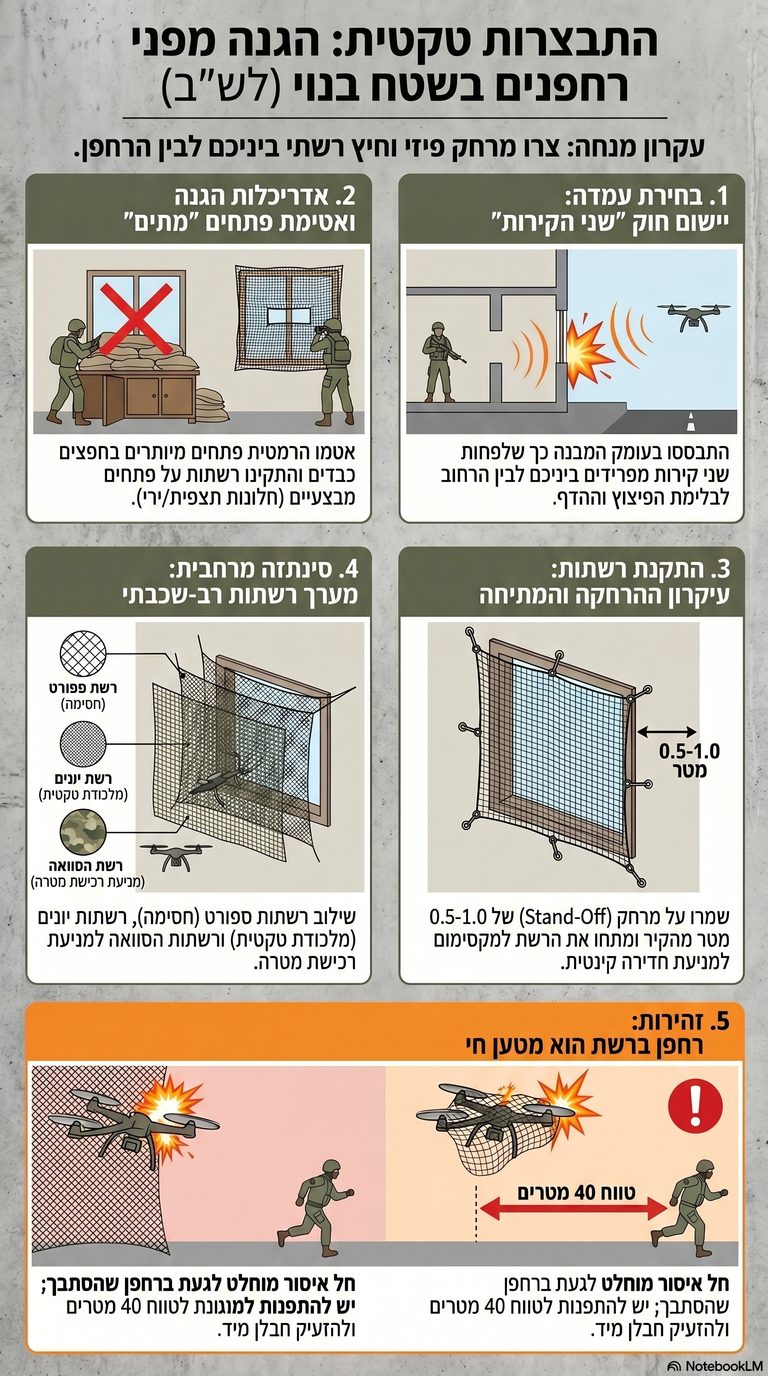
Tactical fortification: defense against drones in built-up areas
The illustration has loaded; the main content also appears later on the page.
Guidance for soldiers / Preparing positions in a red zone
Tactical guide: preparing positions and fortifying in a red zone (urban warfare)
Fortifying in a red zone requires adapting the structure to the precise drone threat, while combining physical protection, exposure discipline, and proper concealment. Below are the operating principles for preparing the position:
01
Position selection and applying the "two-wall rule"
Structure screening: Not every structure provides protection. Thin walls, hollow blocks, or sheet-metal roofs are not enough to stop a drone strike. Shelter should be chosen behind thick concrete walls, in basements, or in interior structures.
The "two-wall" rule: When establishing inside a building, you must move deeper into the space and ensure there are at least two supporting walls between you and the street outside. The first wall absorbs the direct blast, and the second blocks the shockwave and concrete fragments.
02
Defensive architecture for buildings (opening protection)
Blocking "dead" openings: Every nonessential opening (not used for firing or observation) must be sealed hermetically with heavy objects, sandbags, or cabinets.
Protection of operational openings: Windows and doors used for alert status, observation, or firing are major entry paths. Nets must be installed on their outer side.
Window discipline: You must tape "X" marks (blast tape) on windows against glass fragments, and hang thick blankets to block light and heat leakage outward. Never observe directly from the window line — work and observe from deeper inside the room.
03
Installing a net array (the "standoff principle" and tensioning)
Immediate deployment time: Deploying the nets is the first action in the arrival routine on site. Do not wait for a drone to be identified before starting to protect yourselves.
Stand-off principle (Stand-Off): For the net to keep the blast and fragments outside and prevent penetration inward, the required distance between the net and the structure must be 0.5 to 1.0 meters.
Danger of a loose net (must be taut): Installing a loose sports net is a lethal hazard, because the net will "stretch" with the drone's momentum and allow the blast to penetrate the standoff distance. The net must be tensioned and secured as much as possible to cancel its natural flexibility.
04
Spatial synthesis (a multi-layered layout around the position)
Sports nets: Intended for kinetic and physical blocking of key access routes and fighting openings.
Pigeon nets: Used as an invisible tactical trap in enemy cameras. They should be deployed in passages, unexpected alleys, and low flight paths.
Camouflage nets: Intended for psychological warfare and preventing detection. They should be deployed above the command post (operations room) and above fixed positions to prevent target acquisition by the operator.
05
Routine handling of duds
A drone in a net is treated as an explosive device: A drone caught in a net (even if it did not explode) is a live and lethal UXO. It is strictly forbidden to touch it or try to free it. All personnel must be evacuated to a safety distance of 40 meters and an EOD technician called.