The illustration has loaded; the main content also appears later on the page.
Guidelines for soldiers / Preparing buildings in a green zone
Tactical guide: Preparing buildings and establishing in a green zone (rear bases, command centers, and rest areas)
Although a green zone creates an illusion of safety, buildings in these areas (often used as HQ, aid station, or troop quarters) are high-value and preferred targets for enemy drones. Preparing the building requires strict discipline and a combination of concealment, physical blocking, and standoff.
01
Choosing an interior location and stay discipline
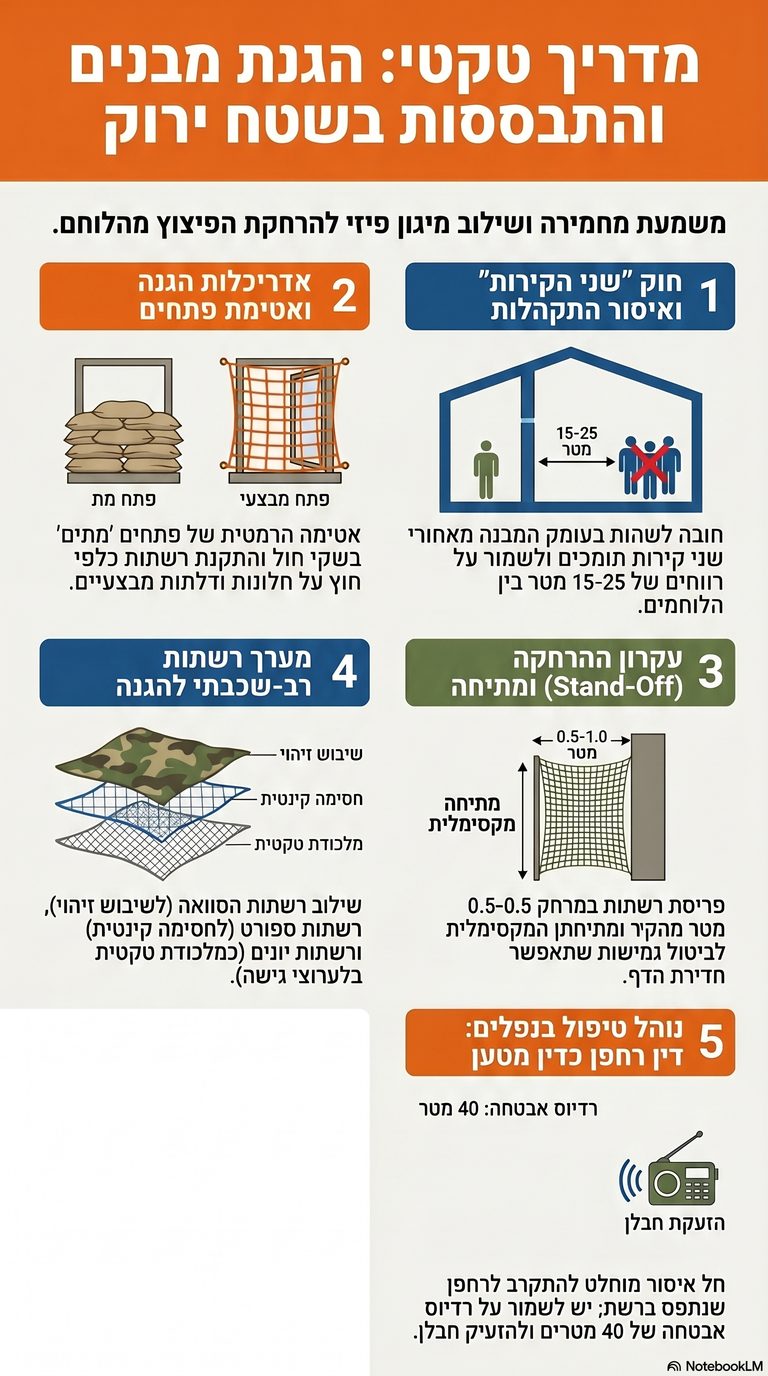
The "two-wall" rule: Even in a building located in the rear, you must move deep into the interior and ensure there are at least two supporting walls between you and the outside. The first wall will absorb the drone’s direct blast, and the second wall will stop the blast wave and concrete fragments.
No gathering: The green environment creates a dangerous tendency toward complacency and gathering near building entrances or supply points. Keep 15-25 meters between soldiers and avoid concentrating personnel, so as not to invite the dropping of heavy munitions.
02
Building defense architecture (opening protection)
Blocking "dead" openings: Every opening, window, or door not essential for observation or passage must be sealed hermetically. Do this using sandbags, cabinets, or other heavy objects.
Protection of operational openings: Windows and doors used for alert status and observation are major entry routes. Nets must be installed on their outer side.
Absolute window discipline: Never observe directly from the window line—work and observe only from deep inside the room. In addition, shatter tape ("X" marks) must be applied to the glass to prevent the spread of glass fragments, and thick blankets should be hung to block light and heat leakage from the building to the outside.
03
Installing a net array (the "standoff principle" and tensioning)
Immediate deployment time: Deploying the nets around the building is the first action in the arrival routine for a green zone. Under no circumstances should you wait for a drone to be detected before starting to protect yourselves.
Stand-off principle (Stand-Off): The goal is to keep the blast wave and fragments outside and prevent them from entering the building. For this, the required distance between the protective nets and the building walls and windows must be 0.5 to 1.0 meters.
Danger of a loose net (must be taut): A net that is not taut is a lethal danger. The net will stretch with the drone’s momentum, allow the explosion to penetrate the standoff distance, and damage the building. The net must be stretched and secured as much as possible to completely cancel its natural flexibility.
04
Spatial layout around the building (multi-layer defense array)
Camouflage nets: Intended for psychological warfare and preventing detection. They should be deployed above buildings used as HQ (command center) and above command posts. Their advantage is blurring the enemy’s analog camera and discouraging the operator from acquiring the target.
Sports nets: They must be installed for physical and kinetic blocking of the lifeline and the building openings, thanks to their durability and high energy absorption capability.
Pigeon nets: Used as an invisible tactical trap. Deploy them around the building, in access alleys, passages, and expected low-flight paths.
05
Iron routine for handling UXO
A drone in a net is treated as an explosive device: A drone caught in the building nets or fallen nearby is a live, lethal UXO, even if it did not explode. It is strictly forbidden to approach it or try to free it. Keep a security radius of at least 40 meters and call an EOD technician/bomb disposal unit to the scene.