The illustration has loaded; the main content also appears later on the page.
Civilian Guidelines / Vehicle Preparation
Preparing civilian vehicles in advance: a guide to physical protection against drones
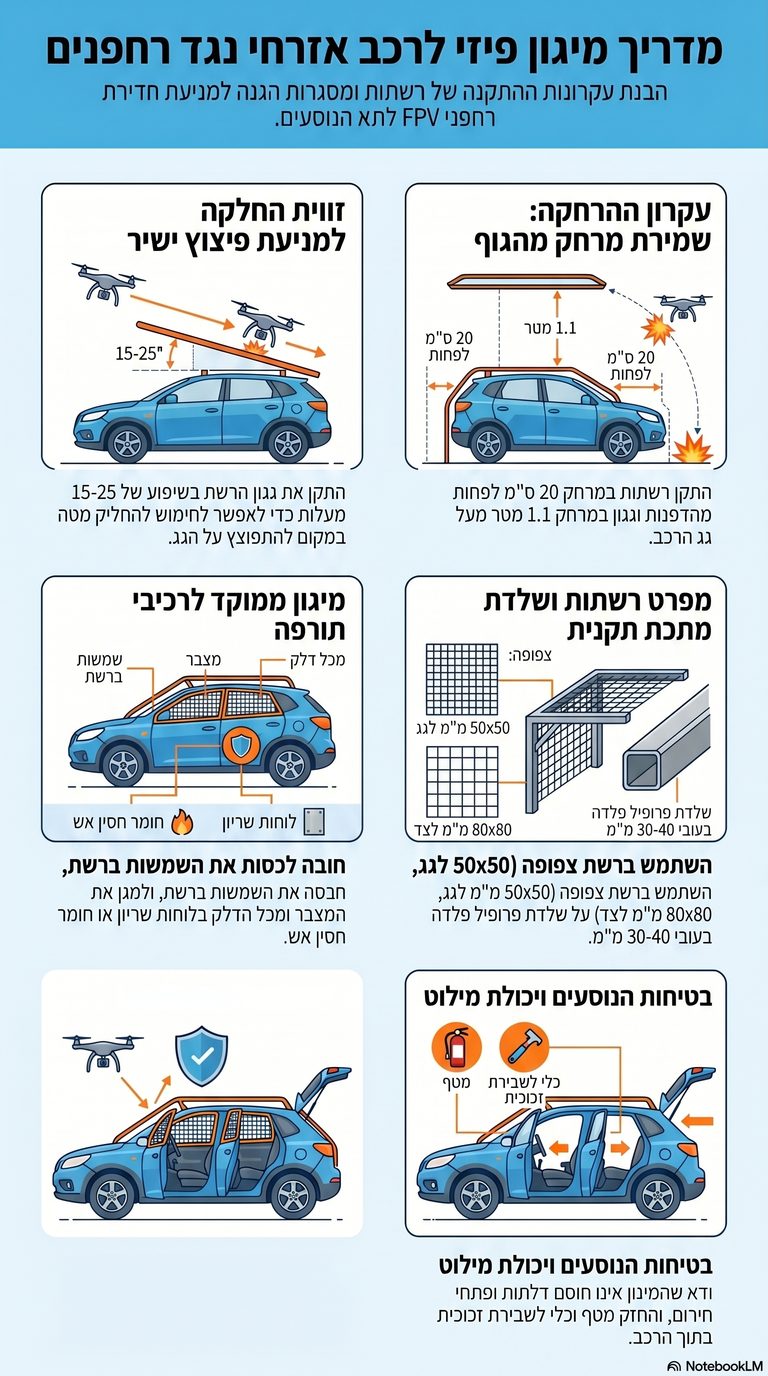
The physical protection principles are based on combat experience and apply to any vehicle moving in a threatened area. Their main purpose is to prevent drones and blast waves from penetrating the passenger compartment and critical engine components. When adapting a civilian vehicle (such as a pickup truck, jeep, or commercial passenger vehicle) to cope with the drone threat, the following rules should be applied:
01
Stand-off principle and frame dimensions
The purpose of the protection is to create a physical barrier that causes the drone to explode outside the vehicle, thereby stopping the blast and fragments before they penetrate inside.
Minimum side clearance: The protective frames and side nets must be installed at least 200 mm (20 cm) from the vehicle body.
Overhead protection (roof cages): Because attack drones (FPV) often dive from above, protective roof cages should be installed at least 1100 mm (1.1 meters) above the vehicle roof.
Deflection angle: The upper net canopy should be made and installed at a slope angle of 15 to 25 degrees relative to the horizon. This slope is intended to allow munitions dropped from the air to slide downward instead of exploding directly on the roof.
02
Net materials and density
For the net to stop a kamikaze drone, standard dense dimensions should be used:
Side nets: Nets with a mesh size between 75x75 mm and a maximum of 80x80 mm should be used.
Roof nets: require higher density to block munitions dropped directly downward, so nets with a 50x50 mm mesh size should be used.
Metal frame: The side frames are recommended to be built from metal tubes or profiles measuring 30x30 mm. The steel supports carrying the upper canopy bear a greater load, and therefore should be made from a profile at least 40x40 mm thick.
03
Focused protection of vulnerable components
Drones may aim at unprotected areas to disable the vehicle and stop it in open terrain. Specific protection must be added to the following points:
Vehicle windows: The windows must be covered with metal mesh, reinforced with protective anti-shatter film, or protected with plastic and wood shields.
Battery: A strike to it will immediately disable the vehicle. The battery should be wrapped with armor plates, a metal shield, or a cover made of dense rubber.
Fuel tank: The fuel tank must be covered with nonflammable material to prevent ignition if struck by a hot fragment.
04
Passenger safety and preserving escape capability
The protection installation is meant to protect the vehicle occupants, and frame parts must not become a trap in case of fire or the need for rapid evacuation.
Unblocked escape openings: The protection mounts must be designed to allow full opening of all doors, windows, and escape openings in the vehicle.
Internal emergency equipment: A working fire extinguisher and a readily available tool for quickly breaking glass (such as a heavy adjustable wrench) should be kept inside the passenger compartment, to allow rapid escape if the doors bend or jam.
Weight and maneuverability: When building the protection setup, make sure the weight does not drastically reduce the vehicle's maneuverability. "Zigzag" driving, sharp turns, and speed changes are critical means of evading drones and disrupting the operator's aiming.