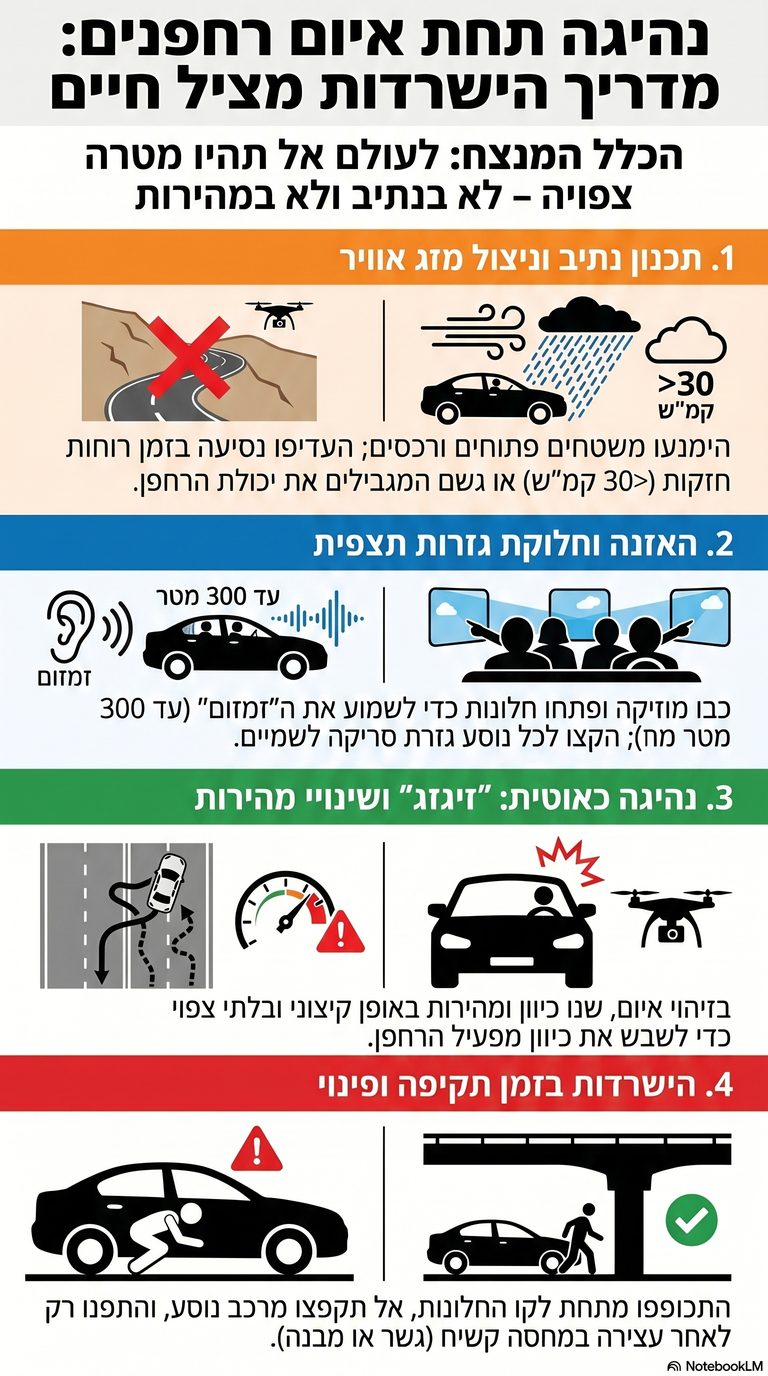
The illustration has loaded; the main content also appears later on the page.
Guidelines for civilians / Travel by vehicle
Civilian driving under drone threat
Principles of preparation and response for civilian travel in an area where there is concern about drones: choosing route and timing, technical vehicle readiness, role allocation in the passenger compartment, and response when a threat is identified.
01
Advance route and timing planning
Route analysis and planning: Avoid driving through open areas such as wide fields or exposed ridges, where the vehicle becomes an easy target. Plan travel along roads that offer natural or artificial cover, such as tree-lined avenues, forests, or dense buildings.
Preparing for GPS disruption: Navigation apps often malfunction or stop working in threat areas. Memorize visual landmarks in advance (specific intersections, bridges, or prominent buildings) to avoid getting lost and lingering unnecessarily in a dangerous area.
Using the weather: FPV drones have difficulty flying in harsh conditions. Driving during strong winds (over 30 km/h), heavy rain, or at twilight significantly limits the enemy’s ability to operate drones.
02
Technical vehicle readiness and securing cargo
Preventing forced stops: Stopping in an open area is extremely dangerous. Before every trip, make sure you have a full fuel tank, and check the engine, oil, coolant, tire pressure, and spare wheel.
Securing loose cargo: If a drone is identified, the driver may be forced to make sharp and sudden evasive maneuvers. Secure any load or equipment well inside the passenger compartment so heavy objects do not fly around and injure passengers during sharp turns.
Accessible emergency equipment: Keep a fire extinguisher and a tool for quickly breaking windows (such as an adjustable wrench) within reach inside the passenger compartment. Make sure doors and windows open easily and are not blocked.
03
Passenger compartment environment and role allocation
Listening for the threat: Turn off the music in the vehicle and open the windows slightly. FPV drones make a distinctive, harsh high-frequency buzzing sound that can be heard from 100-300 meters away, giving critical seconds to react before they are seen.
Assigning "sky watchers": The driver must focus completely on the road and maneuvering. The other passengers in the vehicle should be assigned specific observation sectors (forward, backward, right, left, and up) to continuously scan the sky and the roadside.
Accessible first aid: A personal first aid kit, especially a tourniquet, must be accessible in a pocket or on your body—do not bury it in a bag in the trunk.
04
Emergency protocol during an attack
Never stop in an open area: If a drone is identified, it is absolutely forbidden to stop in an exposed area. The driver must immediately drive in a "zigzag" and change speed drastically (for example sudden acceleration and braking) to disrupt the drone operator’s aim, while driving toward the nearest shelter.
Passenger survival: Passengers must avoid panic, not shout, and under no circumstances try to jump from a moving vehicle. Instead, they should crouch as low as possible, below the window line. Drone operators often aim at visible heads and shoulders; crouching removes that target.
Safe evacuation: Exit the vehicle only after the driver has stopped in a protected place (such as under a bridge, dense trees, or next to a structure). Exit quickly, do not gather near the vehicle, and spread out to find individual shelter.