The illustration has loaded; the main content also appears later on the page.
Guidelines for soldiers / net types
Tactical guide: net types for drone defense and installation principles
The sources detail an arsenal of different nets used to create a "multi-layer defense array" against the drone and FPV threat. Each net has a specific purpose, and there are operational iron rules for installing them correctly.
A
Part A: Net types and their tactical purpose
Sport Net
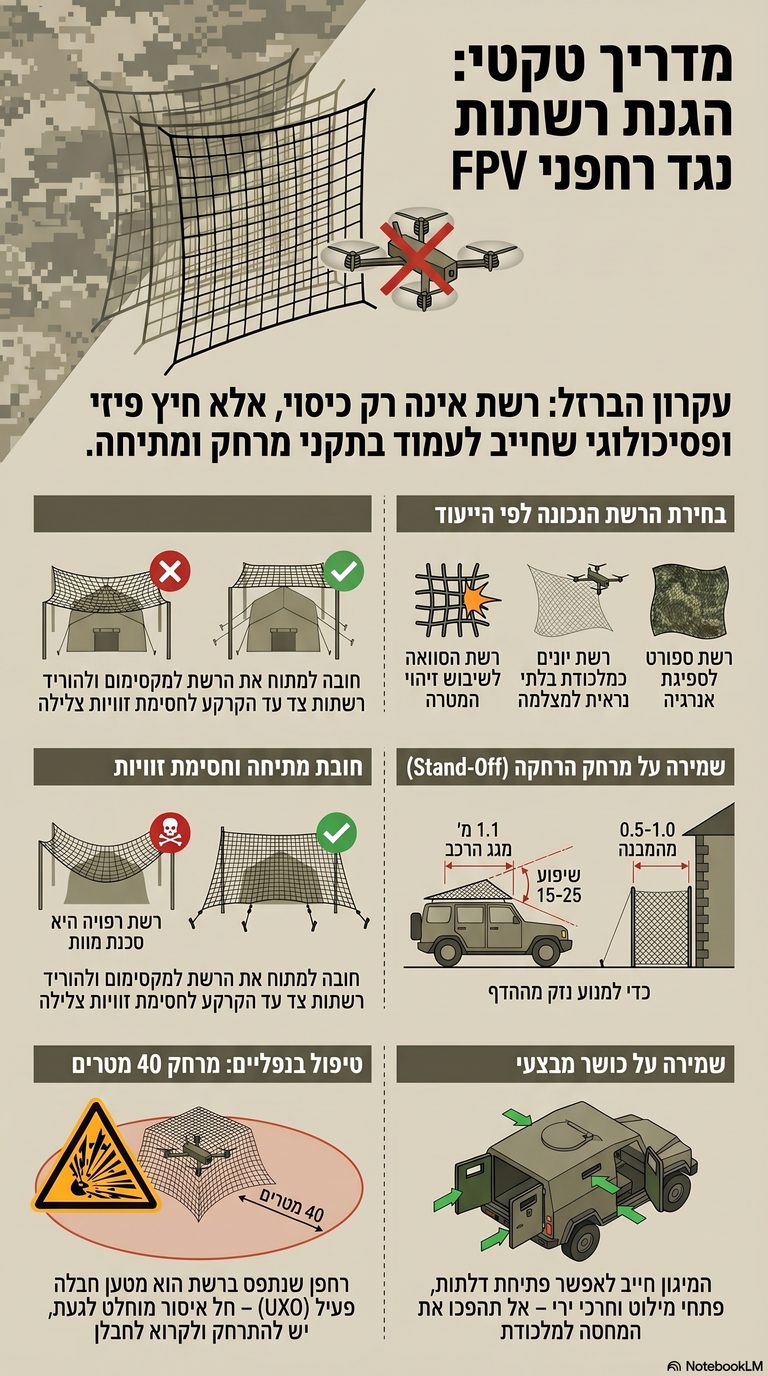
Designed for physical and kinetic blocking of the drone. Its main advantage is durability and high energy absorption. It is used to protect critical access routes in structures, cover operational openings, and set up overhead "protective canopies" above static vehicles (such as medical and logistics vehicles).
Pigeon Net
Used as a tactical trap. Its huge advantage is that it is invisible in the blurred analog camera of the enemy drone. It should be deployed along unexpected approach routes, inside alleys, in narrow passages, and along low flight paths.
Camouflage Net
Used for psychological warfare and target concealment. Its purpose is to prevent the operator from identifying the target, which often causes frustration and abandonment of the attack. It is usually deployed above command posts and static positions. It is important to remember that a camouflage net provides only partial thermal disruption and does not eliminate the body heat signature.
Metal/steel nets (for vehicle and APC protection)
Side nets: It is mandatory to use nets with a mesh size ranging from 75x75 mm up to a maximum of 80x80 mm.
Roof nets: Require higher density, with a mesh size of 50x50 mm.
B
Part B: Iron principles of installation and deployment
Immediate deployment time
Deploying the nets must be the first action in the arrival routine on site. Do not wait for drone detection to begin protecting yourselves.
Stand-off principle (Stand-Off)
The goal of using a net is to create a physical barrier that causes the drone to explode outside and keeps the blast and fragments outside the shelter.
In structures: A distance of 0.5 to 1.0 meter must be maintained between the net and the structure wall or window.
On vehicles: The support frames of side nets must be at least 200 mm from the vehicle body. Upper protective canopies will be installed at a distance of at least 1100 mm from the vehicle roof, at a slope angle of 15-25 degrees relative to the horizon, to allow air-dropped munitions to slide off. The frames themselves will be built from pipes or profiles 30x30 mm in diameter, while the supports carrying the canopies will be built from profile at least 40x40 mm thick.
Danger of a loose net (mandatory tensioning)
Critical safety warning regarding sports nets. A loose, elastic net is a deadly danger, because it will "stretch" with the drone’s momentum and allow it to penetrate inward the required standoff distance before exploding. The net must be stretched and secured as tightly as possible to completely eliminate its natural elasticity.
Blocking the dive angle (perimeter protection)
FPV drone cameras usually do not have a gimbal (stabilizer), so the drone operator is forced to dive at a sharp downward angle toward the target in order not to lose visual contact. Therefore, when setting up a net canopy over a vehicle, it is mandatory to surround it with side nets reaching down to the ground as well, to block drone penetration through low angles beneath the canopy.
Maintaining operational capability
When installing protection on vehicles, the mounts must allow full opening of doors and escape hatches, and leave firing slits so the crew can return fire. In structures, only "dead" openings are sealed hermetically, while openings used operationally for observation or firing are protected with outward-facing nets.
C
Part C: Routine for handling unexploded items caught in a net
A drone that hit a net and became entangled in it (even if it did not explode) becomes a live, active, and deadly explosive hazard (UXO). Iron rule: do not touch it. It is absolutely forbidden to approach the drone or try to free it from the net. The force must be evacuated immediately to a safety distance of at least 40 meters, and an EOD technician or bomb disposal team must be called to the scene.