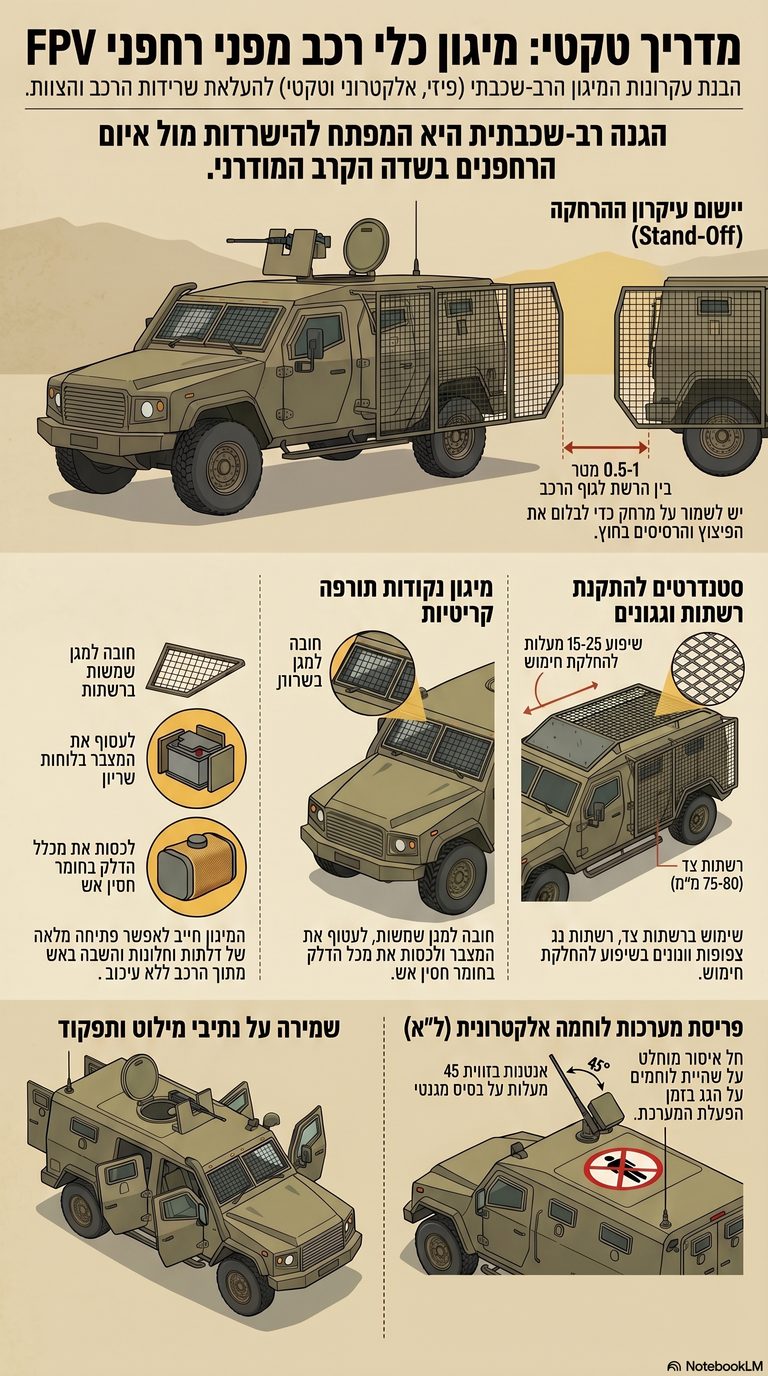
The illustration has loaded; the main content also appears later on the page.
Guidance for soldiers / Preparing vehicles and armored vehicles
Tactical guide: Protecting vehicles and tanks from attack drones and FPV
The best protection for vehicles and armored vehicles against aerial attack threats is a layered protection setup combining nets, metal frames, and armor plates. Below are the operational protection and installation principles:
01
The stand-off principle and frame installation
Blast containment outside: The purpose of the protection is to keep the blast wave and fragments outside the vehicle and prevent penetration inside. To do this, a distance of 0.5 to 1.0 meter should be maintained between the nets and the vehicle/building body.
Minimum distances: When installing side frames, keep a distance of at least 200 mm from the vehicle body.
Overhead protection (roof cages): Protective canopies above the vehicle roof or the manned turret (in tanks and APCs) must be installed at a distance of at least 1100 mm from the hull. To allow airborne munitions to slide off, the canopy should be built with a 15 to 25 degree slope relative to the horizon.
02
Standard net materials and sizes
Side nets: Use nets with a mesh size of at least 75x75 mm, but no more than 80x80 mm.
Roof nets: Denser nets should be used, with a mesh size of 50x50 mm.
Frame and support: The frames are recommended to be built from metal profiles or pipes with a diameter of 30x30 mm, while the steel supports carrying the overhead canopies should be made from profiles at least 40x40 mm thick.
03
Focused protection for critical components
When installing protection, priority should be given to protecting the vehicle’s weak points:
Windows: Must be covered with metal mesh, reinforced with protective sheets, or covered with wood and plastic shields.
Battery: The battery should be wrapped with armor plates, a metal shield, or dense rubber to prevent the vehicle from being disabled.
Fuel tank: Must be covered with non-flammable material to prevent ignition in the event of impact by a hot fragment.
04
Maintaining operational function and escape capability
Clearance openings: The protection mounts must be designed to allow full opening of doors, windows, and escape hatches.
Return-fire capability: Frame installation must leave firing ports that allow the crew to use personal weapons from inside the vehicle in case of an ambush. Installing protection should not impair maneuverability or delay evacuation of the vehicle under fire.
05
Perimeter protection while parked (for medical and logistics vehicles)
Medical and logistics vehicles are sensitive targets. When parked statically, an upper protective canopy of nets must be deployed above them.
Dive risk: Drone operators tend to dive and enter under canopies. Therefore, the vehicle must also be surrounded with perimeter nets (down to the ground) to block entry from low angles beneath the main canopy.
06
Integrating EW measures on the vehicle
Antenna installation: The antenna modules should be installed on a flat metal roof base, with strong magnetic mounting. The antennas should be positioned at a 45 degree angle to the horizon, perpendicular to the vehicle’s longitudinal axis.
Electrical and radiation safety: Before connecting the connection cables to the unit, the power supply must be turned off. An EW system must not be connected to the vehicle’s electrical system without a protective fuse. It is also strictly forbidden to carry personnel on the vehicle roof while the system is operating, and standing near or servicing the vehicle close to transmitting antennas should be avoided.